


Buyer & Seller Guide · Long Island's North Shore
Bluff Homes on Long Island's North Shore: What Buyers and Sellers Need to Know
Erosion, drainage, seawalls, permits, disclosure and insurance, in plain English
A house on a bluff over Long Island Sound or one of the North Shore harbors gives you something you can't get on the South Shore: height. Sunsets over the water, Connecticut on a clear day, and a beach at the bottom of the hill.
It also comes with something most buyers never think about until they're standing at the edge. The bluff is moving. Sometimes slowly, sometimes all at once.
This guide covers both sides. If you're buying, here's what to check before you fall for the view. If you're selling, here's how to get ahead of the questions a buyer's engineer is going to ask.
Jump to: Why bluffs move · Recent North Shore bluff failures · Buying · Selling · Permits · Disclosure & insurance · FAQs
Homes for sale: Browse North Shore bluff communities
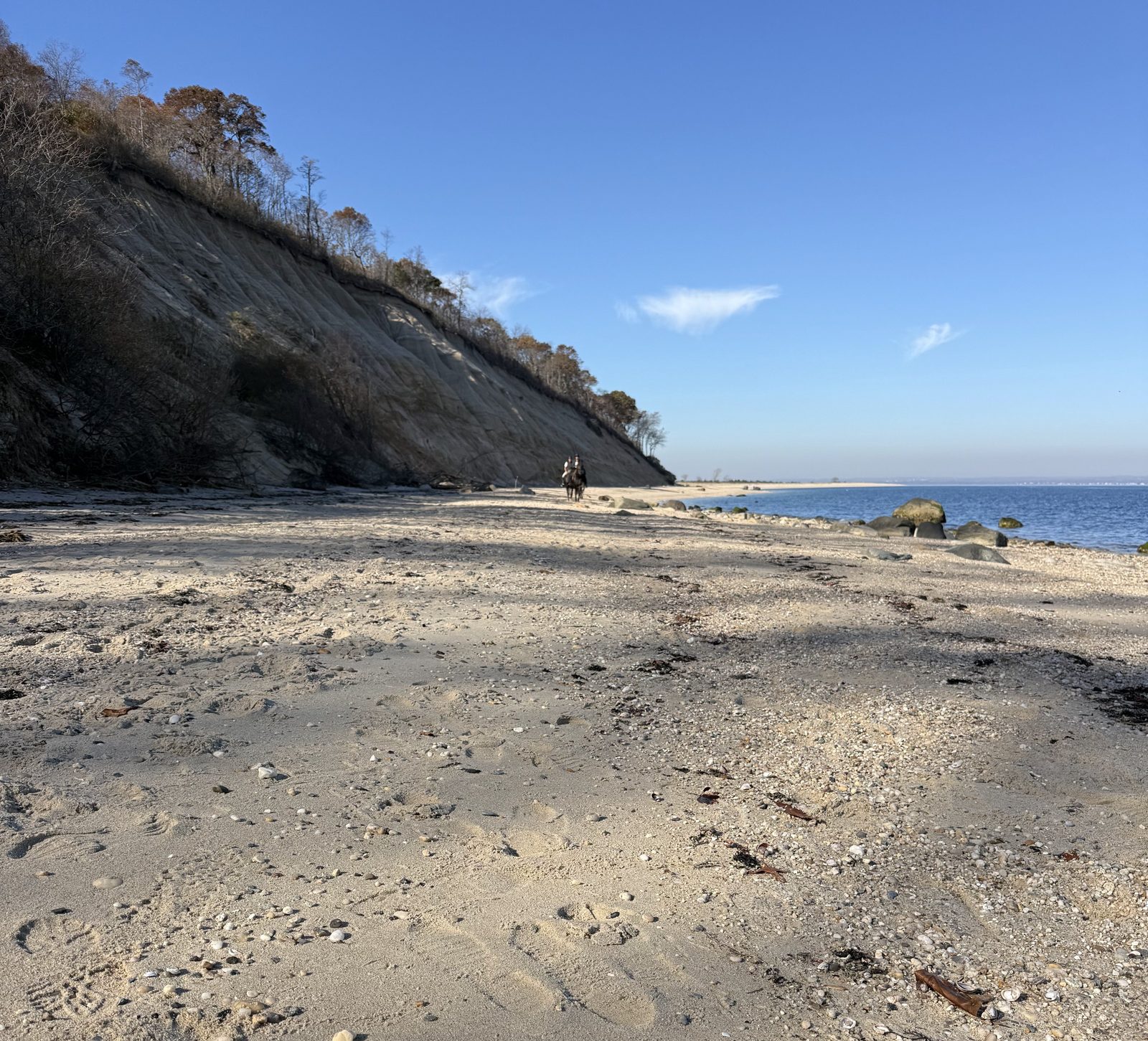
The eroding bluff at Caumsett State Park on Lloyd Neck. The horseback riders at the bottom give you the scale. Original photo by John Cordeira.
Why North Shore Bluffs Move
North Shore bluffs aren't rock. They're loose sand and glacial sediment, and that makes them much weaker than they look from the top.
Two forces work on them. Waves hit the bottom, called the toe, and carry sand away. Water also comes from above: rain, runoff from yards and driveways, and groundwater seeping out of the face. New York's Department of Environmental Conservation counts all of it as erosion, not just the waves.
Bluff erosion is also natural. It's an important source of the sand on North Shore beaches. The problem is a house sitting on top of it.
What Erosion Looks Like
New York Sea Grant lists the warning signs:
- Toppled or leaning trees along the edge
- Gullies and channels cut into the face
- A lip of grass or roots hanging over the edge
- Bare, vertical sections where the slope has dropped away
- Waves reaching the base of the bluff
I saw every one of those on my hike down to the beach at Caumsett. I sat down for a snack, looked up and realized part of the bluff right above me had already slid. I moved closer to the water. A buyer touring a bluff home should look up the same way.
Recent Bluff Failures on the North Shore
This isn't theoretical. Here's a sampling of what's been reported along the North Shore, with links to the original coverage.
Rocky Point, 2013: Brookhaven had condemned a vacant home at the edge of a high bluff over the Sound, and neighbors worried about its stability above the beach. NBC New York In coverage of the same stretch after Sandy, one neighbor reported losing about 80 feet of backyard to storms. CBS New York
Sound Beach, 2013: One Shore Drive home had already been condemned by the Town of Brookhaven, and another was threatened by erosion tied to a drainage pipe broken during Sandy. Patch The Town later stabilized a badly eroded section of bluff at Shore Road and Amagansett Drive with fill, a stone revetment, terracing and native plantings. TBR News Media
Sea Cliff, 2014: Heavy rain triggered a landslide that took much of the driveway and backyard of a Bay Avenue home down the bluff. The house was evacuated and no one was hurt. The owner had recently spent $150,000 on a new retaining wall. News 12
Sea Cliff, 2021: The remnants of Hurricane Ida washed out the embankment behind a hillside home, and old concrete retaining walls that had survived Sandy collapsed under water pressure. CBS New York
Manorhaven, 2021 and 2024: A cliff behind one family's home first came down during Ida, and a 2024 storm sent more mud, water and sand toward their backyard. News 12
Rocky Point, 2024: Most of a private road on a 120-foot bluff fell toward the Sound, leaving the slope a few feet from one homeowner's retaining wall. News 12
Kings Park, 2026: Winter storms stripped sand and soil from the bluffs and destroyed beach stairs. A Stony Brook coastal researcher noted that unlike a sandy beach, an eroded bluff can't really be rebuilt. CBS New York
Notice how many of these started with rain, not waves. Drainage matters as much as the seawall.
Buying a Bluff Home: What to Check Before You Fall for the View
The view sells the house. Your job is to find out what's holding it up.
How Close Is the House to the Edge?
Walk it yourself and look at a survey. Then check whether the property is inside a mapped Coastal Erosion Hazard Area. DEC's maps cover the entire coastline of Long Island, and you can look up a property on DEC's DECinfo Locator by turning on the Coastal Erosion Hazard Areas layer.
Where Does the Water Go?
Follow the gutters, downspouts, driveway and patio drains. If water from the house or yard pours over the edge of the bluff, that's a problem. Inside a Coastal Erosion Hazard Area, grading or soil work on a bluff can't send runoff over the face.
What's at the Bottom?
Look at the toe of the bluff. Is there a stone revetment, seawall or bulkhead? What shape is it in, how old is it, and was it permitted? Sea Grant's guidance is blunt: if waves are reaching the base, plantings alone won't stop the erosion.
What Does the Face Look Like?
Look for bare patches, gullies, slumps, leaning trees and overhanging roots. Healthy, dense vegetation is a good sign. Fresh sand at the bottom and raw scars at the top are not.
Bring in the Right People
A general home inspection is focused on the house. For a bluff property, ask whether a geotechnical or coastal engineer should evaluate the bluff, the wall and the drainage before you're locked in.
Ask for the Paperwork
Request permits, engineering reports, wall and revetment repair history, drainage work and any survey that shows the bluff edge. A seller who did the work right usually has the records.
Planning to Expand?
Find out first. In mapped Structural Hazard Areas, new permanent structures and major additions are prohibited. On the bluff itself, smaller additions may be allowed only with a coastal erosion permit.
Get Insurance Quotes Early
Talk to an insurance agent before you're committed, and ask specifically how the policy treats earth movement. More on that below.
Selling a Bluff Home: Get Ahead of the Buyer's Engineer
Serious buyers for bluff property are going to ask hard questions, and their engineer is going to walk your bluff. The sellers who do best are the ones who answer those questions before anyone asks.
Pull Your Records Together
Gather permits for any wall, revetment, stairs or drainage work, engineering reports, contractor invoices and your survey. A clean paper trail tells a buyer the bluff has been managed, not ignored.
Fix Drainage the Right Way
If downspouts or yard runoff are dumping over the edge, fixing that before you list is often one of the most useful things you can do. Just don't touch the bluff without checking permits first.
Don't Do Unpermitted Bluff Work
Inside a Coastal Erosion Hazard Area, excavating or grading a bluff is generally prohibited, and building or modifying a wall or revetment requires a permit. Unpermitted work can turn into a buyer's objection or a problem at closing.
Disclose Accurately
New York sellers of one-to-four family homes now have to deliver the Property Condition Disclosure Statement. The old $500 credit option is gone. Talk to your attorney about how bluff conditions, erosion history and past repairs should be handled.
Price It Honestly
A bluff view is a real premium, but buyers also weigh the condition of the bluff, the wall and the drainage. Pricing has to account for both. Here's how I approach setting a list price.
Permits: Who to Call Before You Touch a Bluff
New York's Coastal Erosion Hazard Areas Law (Environmental Conservation Law Article 34) and DEC's regulations (6 NYCRR Part 505) control what can be built or disturbed along the coast. Here's what matters for a homeowner.
The Two Zones
- Natural Protective Feature Areas include beaches, dunes and bluffs. Under DEC's definition, a bluff extends 25 feet landward of its peak, so part of your yard may count.
- Structural Hazard Areas sit landward of those features where the shoreline is receding at a long-term rate of at least one foot per year.
What Usually Needs a Permit
- Building or placing a structure, or a major addition
- Grading, excavating, filling or other soil disturbance
- Building, modifying or restoring a seawall, revetment or other erosion protection structure
What Usually Doesn't
- Normal maintenance, meaning same-kind repairs that don't change a structure's size, design or function
- Elevated stairs or walkways a homeowner builds solely for non-commercial access to the beach
Even then, other agencies such as the U.S. Army Corps of Engineers, the NYS Department of State or the Office of General Services may have a say, and tidal wetlands rules can apply.
Local Program or DEC?
Some municipalities run their own DEC-certified coastal erosion program. If yours does, you start with the local building or zoning department. The Village of Lloyd Harbor, for example, adopted its own coastal erosion management law in 1989. Everywhere else, DEC issues the permit.
Rules and local laws change, so confirm with the building department or DEC before any work starts. DEC's Coastal Erosion Management Permit Program page has the maps, the list of certified communities and the application forms.
Disclosure and Insurance
Seller Disclosure in New York
Since March 20, 2024, New York sellers of one-to-four family homes can no longer hand the buyer a $500 credit instead of completing the Property Condition Disclosure Statement. The form also added questions about flood zones, flood history and flood insurance. Sellers should answer it accurately and get their attorney's advice on anything bluff-related.
Homeowners Insurance and Earth Movement
Earth movement, including landslides and mudflows, is a common exclusion in homeowners policies, and flood insurance generally doesn't cover it either, even when flooding caused it. New York courts have enforced these exclusions, including in a 2012 appellate case where heavy rain and a clogged drain set off the landslide.
Every policy is different. Read the actual exclusions, and ask your agent directly what is and isn't covered on a bluff property.
North Shore Bluff Communities
Bluffs run along much of the North Shore, from the harbors of Nassau County out through Brookhaven. Here's how they show up in the communities where they come up most, west to east. Not every home in these places sits on a bluff, so ask me if you want to know which ones do.
Nassau County
Sea Cliff
The village in the Town of Oyster Bay is named for exactly what it sits on: a bluff over Hempstead Harbor. Streets climb steeply from the water, and Sea Cliff has had two well-documented failures, the 2014 Bay Avenue landslide and the Ida washouts in 2021.
Glen Cove
Sea Cliff's neighbor to the north. Glen Cove's shoreline wraps from Hempstead Harbor onto the Sound, and some of its waterfront homes sit high above the water.
Suffolk County: Town of Huntington
Lloyd Harbor
The village includes Lloyd Neck, the peninsula where Caumsett State Historic Park Preserve sits on the Sound. That's the bluff in the photo at the top of this page. Lloyd Harbor adopted its own coastal erosion law, so check with the Village before any bluff work.
Huntington
Lloyd Harbor and Caumsett are both in the Town of Huntington. My Huntington guide covers Huntington, Huntington Station and Huntington Bay, including the harbor and the Town beaches.
Cold Spring Harbor
Steep, wooded hills drop straight to the harbor here. My hike out of Cold Spring Harbor packed almost 900 feet of climbing into just under six and a half miles, which tells you what the terrain is like for homes on the slopes.
Suffolk County: Smithtown and Brookhaven
Kings Park
In the Town of Smithtown. The winter storms of 2026 stripped the bluffs here and took out beach stairs.
Sound Beach
In the Town of Brookhaven. After Sandy, homes along Shore Drive were condemned or threatened, and the Town later stabilized a badly eroded stretch of bluff at Shore Road and Amagansett Drive with a stone revetment, terracing and native plantings.
Rocky Point
Also in Brookhaven, with some of the tallest bluffs in these reports, roughly 100 to 120 feet over the Sound. Rocky Point has seen a condemned bluff-edge home and, in 2024, a private road sliding down the cliff.
More: Long Island waterfront homes · Luxury waterfront homes
Bluff Homes FAQs
Why do bluffs collapse on Long Island's North Shore?
North Shore bluffs are made of loose sand and glacial sediment. Waves erode the base, while rain, runoff and groundwater weaken the slope from above. Heavy rain is behind many of the failures reported in recent years.
How do I find out if a property is in a Coastal Erosion Hazard Area?
Use DEC's DECinfo Locator and turn on the Coastal Erosion Hazard Areas layer, or check the CEHA maps on DEC's coastal erosion permit page. In a certified community, the local building department also has the maps.
Do I need a permit to repair a seawall or revetment on a bluff?
Usually, if it's inside a Coastal Erosion Hazard Area. Building, modifying or restoring an erosion protection structure requires a permit. Same-kind repairs that don't change a structure's size, design or function are treated as normal maintenance. Confirm with your building department or DEC first.
Can I build an addition on a bluff property?
It depends on the zone. New permanent structures and major additions are prohibited in mapped Structural Hazard Areas. On the bluff itself, additions under 25 percent of the existing footprint may be allowed with a coastal erosion permit.
Does homeowners insurance cover a landslide or bluff collapse?
Often it doesn't. Earth movement, including landslides, is a common exclusion in homeowners policies, and flood insurance generally excludes it too. Read your policy and ask your agent.
Do New York sellers have to fill out a disclosure form?
Yes. Since March 20, 2024, sellers of one-to-four family homes must deliver the Property Condition Disclosure Statement before the buyer signs the contract. The $500 credit option was eliminated. Ask your attorney how bluff conditions and past repairs should be disclosed.
Buying or Selling on a Bluff? Talk to Me First.
My specialty is genuinely helping people. If you're buying, that means telling you what I see before you fall for the view. If you're selling, it means telling you the truth about your house before a buyer's engineer does.
I'll walk the property with you, point out what concerns me, and tell you when it's time to bring in an engineer. I'm John Cordeira, Broker/Owner of Cordeira Homes, with more than 20 years in Long Island real estate.
What Should I Add to My Bluff Homes Guide?
If you live on a North Shore bluff, you know things no permit page will tell you: what your wall went through in the last big storm, which drainage fix actually worked, what your engineer flagged. Engineers and contractors who work on these bluffs, I want to hear from you too. Tell me what's missing and I'll look into it.
This guide is general information, not legal, engineering or insurance advice. Rules, maps and local laws change. Confirm the details for any specific property with the appropriate attorney, engineer, insurance professional, building department or DEC.
John Cordeira
Broker/Owner, Cordeira Homes
Long Island, New York